

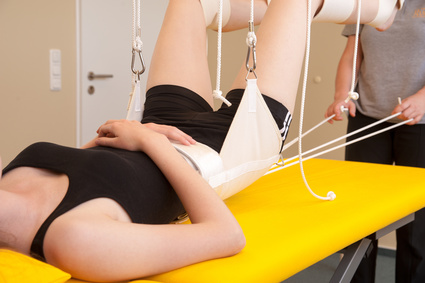
Der Schlingentisch wird in der Physiotherapie als Therapiehilfsmittel benutzt, um die betroffenen, schmerzhaften oder auch unbeweglichen Gliedmaßen zu behandeln. Die bauliche Ausführung besteht aus einem circa zwei Meter hohen, genau so langen und einen Meter breiten, stabilen Stahlrahmengestell, der das Aussehen eines überdimensionierten Tisches hat. Spezialausführungen können auch umgedreht von der Decke hängend befestigt sein. Auf diesem Rahmen ist meist ein Drahtgitter verschweißt.[ In das Gitter werden Seile oder Schnüre mit daran befestigten „Schlingen (genauer: offene Schlaufen, breite Gurte, Bänder, Manschetten etc.), sowie auch einfache Flaschenzüge, oder einzelne Rollen variabel mit Karabinerhaken eingehängt, verknotet oder anderweitig befestigt. Die fachliche Bezeichnung hierfür nennt sich „Schlingenbesteck“.
Der Patient befindet sich auf einer Liege darunter und kann so an den betroffenen Körperabschnitten oder auch komplett hochgezogen werden. Die einzelnen Anwendungen sind jedoch abhängig von der Diagnose und der therapeutischer Zielsetzung.
Der Schlingentisch ist somit für bestimmte orthopädische Diagnosen ein unverzichtbarer Bestandteil der physiotherapeutischen Behandlung.
Anwendungsbeispiele:
Quelle:Wikipedia
Copyright © 2022 Physio-Medic
| Cookie | Dauer | Beschreibung |
|---|---|---|
| cookielawinfo-checkbox-advertisement | 1 year | Set by the GDPR Cookie Consent plugin, this cookie is used to record the user consent for the cookies in the "Advertisement" category . |
| cookielawinfo-checkbox-analytics | 11 months | This cookie is set by GDPR Cookie Consent plugin. The cookie is used to store the user consent for the cookies in the category "Analytics". |
| cookielawinfo-checkbox-functional | 11 months | The cookie is set by GDPR cookie consent to record the user consent for the cookies in the category "Functional". |
| cookielawinfo-checkbox-necessary | 11 months | This cookie is set by GDPR Cookie Consent plugin. The cookies is used to store the user consent for the cookies in the category "Necessary". |
| cookielawinfo-checkbox-others | 11 months | This cookie is set by GDPR Cookie Consent plugin. The cookie is used to store the user consent for the cookies in the category "Other. |
| cookielawinfo-checkbox-performance | 11 months | This cookie is set by GDPR Cookie Consent plugin. The cookie is used to store the user consent for the cookies in the category "Performance". |
| CookieLawInfoConsent | 1 year | Records the default button state of the corresponding category & the status of CCPA. It works only in coordination with the primary cookie. |
| elementor | never | This cookie is used by the website's WordPress theme. It allows the website owner to implement or change the website's content in real-time. |
| viewed_cookie_policy | 11 months | The cookie is set by the GDPR Cookie Consent plugin and is used to store whether or not user has consented to the use of cookies. It does not store any personal data. |
| Cookie | Dauer | Beschreibung |
|---|---|---|
| CONSENT | 2 years | YouTube sets this cookie via embedded youtube-videos and registers anonymous statistical data. |
| Cookie | Dauer | Beschreibung |
|---|---|---|
| VISITOR_INFO1_LIVE | 5 months 27 days | A cookie set by YouTube to measure bandwidth that determines whether the user gets the new or old player interface. |
| YSC | session | YSC cookie is set by Youtube and is used to track the views of embedded videos on Youtube pages. |
